My first real road trip nearly ended forty minutes from home. The fuel light came on in the middle of a stretch of road with no petrol station in sight, my phone had no signal, and the friend sitting next to me, who had sworn he knew the way, was asleep. We coasted into a village on fumes and luck. The trip that followed was wonderful, but that first hour taught me the lesson every beginner learns eventually: a road trip is only as relaxing as the small amount of planning you did before turning the key. Every experienced driver has a story like that, which is why a proper road trip guide for beginners starts a week before the wheels turn, not at the petrol station.
Table of Contents
- Plan the Route Around a Theme, Not a Checklist
- Give the Car a Health Check a Week Before You Leave
- Pack for the Cabin, Not Just the Destination
- Budget With a Buffer, and Track It Lightly
- Drive Like the Trip Matters
- Keep Exploring
- Frequently Asked Questions
- What should a road trip guide for beginners always include?
- How many kilometres a day is realistic for a first road trip?
- What should I do if the car breaks down somewhere with no town nearby?
- Is it wiser to book every night’s stay in advance or find rooms as I go?
- How do I keep children and restless passengers content on the long stretches?
- What is the one mistake almost every first-time road tripper makes?
- One Last Thing Before You Turn the Key
That is the honest difference between a road trip and a flight. On a plane, the journey is dead time between two places. In a car, the journey is the holiday itself: the landscapes changing through the windscreen, the roadside stall you stopped at on a whim, the conversation that only seems to happen at ninety kilometres an hour. If you have never taken one, this guide walks you through your first trip the way I wish someone had walked me through mine: the route, the car, the packing, the money, the driving, and the mistakes worth skipping.
Plan the Route Around a Theme, Not a Checklist
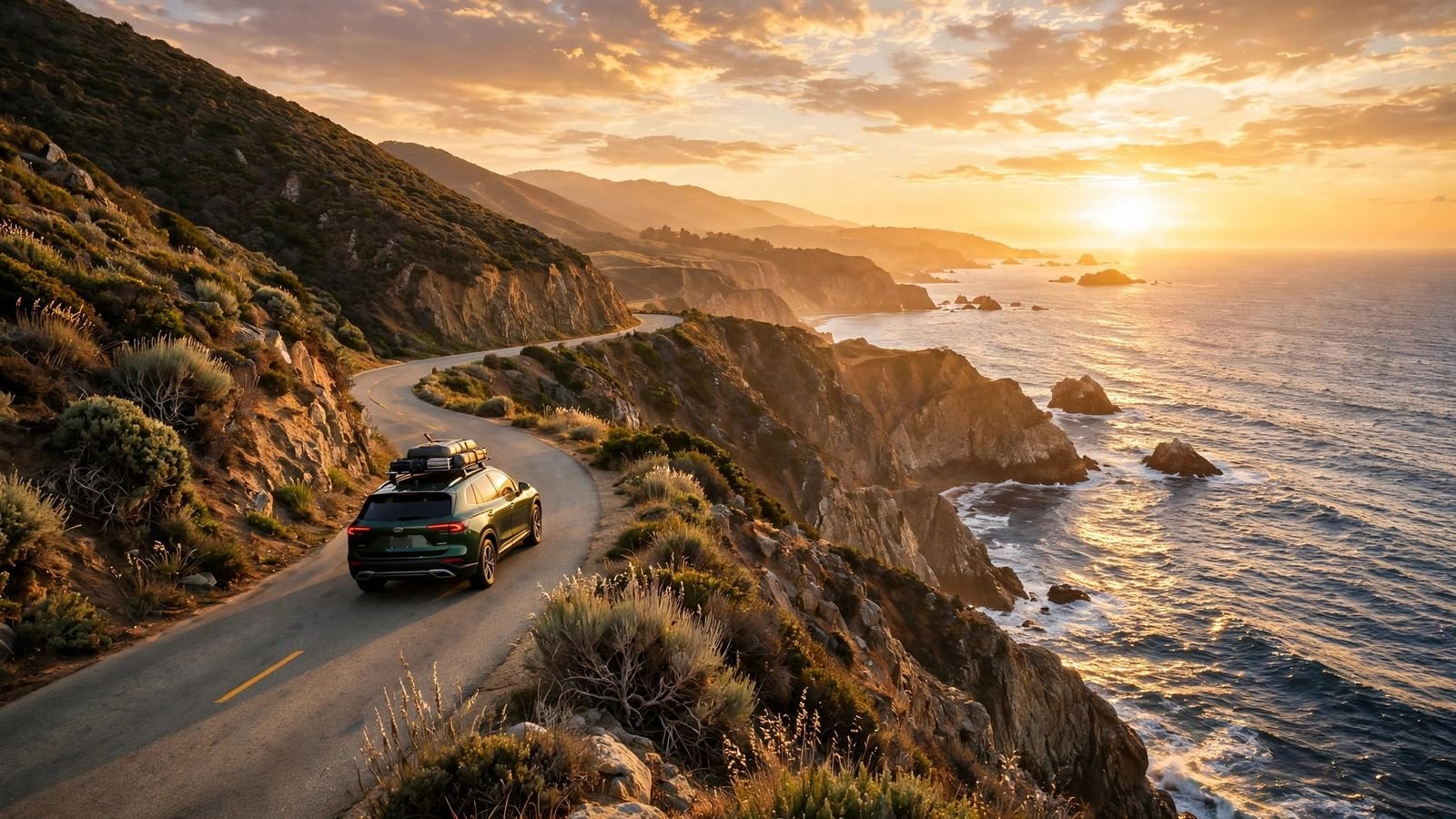
Beginners usually make the same planning mistake: they open a map, pin fifteen places, and build an itinerary so tight it collapses by day two. A better approach is to choose a theme and let the theme do the organising. Mountains. A coastline. Old towns and the slow roads between them. Once you know the flavour of the trip, the stops suggest themselves, and just as importantly, the things you skip stop feeling like losses.
Keep daily driving to four or five hours. That number surprises people, but it is the line between travelling and enduring. Five hours behind the wheel, with fuel stops and a long lunch, fills a day completely. Push to eight and you arrive at each destination too tired to enjoy it, which quietly defeats the entire point. Plot your overnight towns in advance so you always know where the day ends, then leave the hours between start and finish deliberately loose.
Loose is not the same as careless. Before you leave, mark the long empty stretches on your route, the parts with no fuel, no food and no signal, and note roughly where the bigger towns fall. The best story from my own trips, a tiny hilltop café we found by following a hand-painted sign, happened because we had time in the day and fuel in the tank. Spontaneity works best when the basics are already handled.
Give the Car a Health Check a Week Before You Leave
Do this a week before departure, not the night before, so a problem found is a problem you can fix. Walk around the car slowly. Check the tyres for tread and pressure, and check the spare with the same seriousness, because a flat spare is a classic roadside discovery. Look at the brakes: if they squeal, grind, or the pedal feels soft, get them seen to. Test every light, including the brake lights, and replace wiper blades that smear.
Under the bonnet, the list is short: engine oil, coolant, brake fluid and screen wash, topped up and at the right levels. Batteries rarely fail in your own driveway. They fail at a scenic viewpoint two hundred kilometres from the nearest town, usually on the hottest day of the trip. If your battery is more than three or four years old, a quick test at a parts shop is cheap insurance. Keep your documents, licence, registration and insurance, as photos on your phone plus one printed set in the glovebox.
Then assemble the kit that lives in the boot:
- Jumper cables, plus thirty seconds spent learning where your battery terminals are
- A torch with fresh batteries, because breakdowns ignore daylight
- A phone power bank, fully charged, and a car charger
- Two litres of drinking water that nobody touches except in a real need
- A basic first-aid kit, a warning triangle and a high-visibility vest
- A roll of strong tape and a few cable ties, which temporarily fix more than you would expect
None of this is expensive, and most of it will sit untouched for years. That is fine. The kit is not there for the trip you planned. It is there for the twenty minutes you did not.
Pack for the Cabin, Not Just the Destination
There are two kinds of luggage on a road trip: the bags in the boot that you open at night, and the small bag at your feet that you open fifty times a day. Beginners pack the first kind carefully and the second kind not at all, then spend the trip digging through suitcases at fuel stops. Keep a cabin bag within arm’s reach of the front seats and treat it as sacred.
In ours there is always water, snacks that do not melt or crumble everywhere, wet wipes, tissues, sunglasses, a light jacket each, any daily medication, and a small rubbish bag, which sounds trivial until day three in a car without one. Add sunscreen even in mild weather; the arm resting by the window quietly burns on long drives. Keep one charging cable in the cabin rather than the boot, because the phone doing navigation duty will not survive the day on a single charge.
Download before you leave. Save maps for the whole route for offline use, because mountain roads and mobile signals are old enemies, and the connection always dies exactly where you need directions most. Download music and a couple of audiobooks too. A shared playlist that everyone adds to before the trip turns dead miles into something people actually remember.
Budget With a Buffer, and Track It Lightly
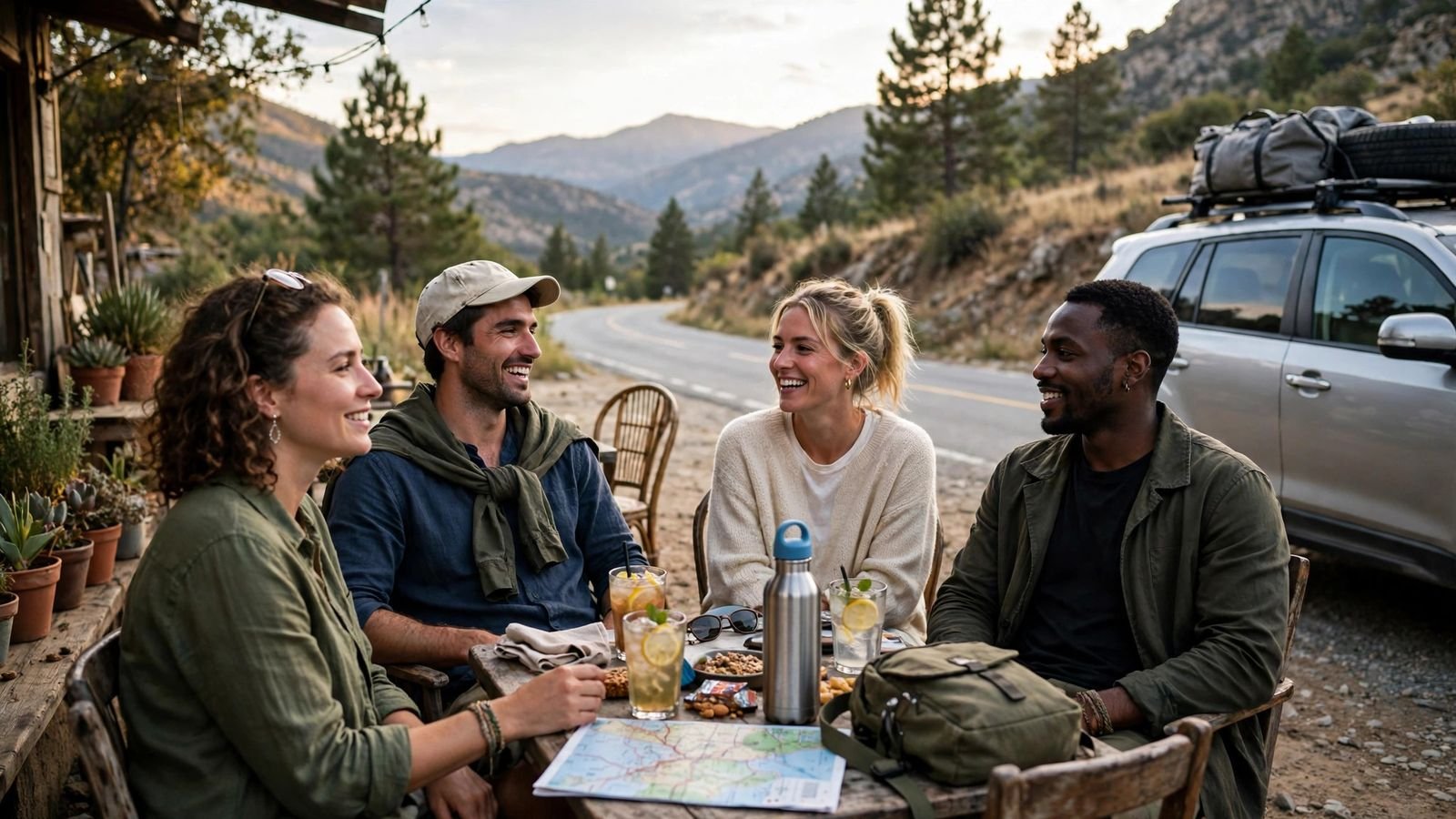
A road trip budget has five honest categories: fuel, tolls, places to sleep, food, and the small stuff, meaning parking, entry tickets and the ice creams that appear from nowhere. Estimate each one before you leave, using your car’s real fuel consumption rather than the optimistic figure in the brochure. Then add twenty percent on top of the total. That buffer is not pessimism. It is the price of a punctured tyre, a wrong turn that costs an hour of fuel, or a town so lovely that you stay an extra night.
Tracking the money should take thirty seconds a day, no more. Keep one shared note on a phone and update it at each evening stop: fuel 60, room 85, dinner 40. When people skip this, it is rarely the grand total that shocks them at the end. It is discovering that the small stuff quietly became a third of the whole budget. Knowing the running total also makes decisions easier. Splurge on the famous seafood place tonight? The note says yes, comfortably. That is exactly what the buffer is for.
Drive Like the Trip Matters
Here is the thing nobody tells you: on a road trip, how you drive shapes the holiday as much as where you go. Tired, rushed driving does not just risk safety, it flattens everyone’s mood, and the passengers feel it long before the driver admits it. Stop every two hours at a minimum. Get out, stretch, swap drivers if there is a second licence in the car, and let the stop be a real stop rather than a fuel-and-dash.
Never let the schedule bully you into driving tired. The maths is brutal and simple: arriving an hour later and happy beats arriving on time and hollow, and arriving at all beats every other outcome. If your eyes get heavy, the trip is telling you the day is over, so find the nearest decent town rather than the planned one. Hotels exist in unplanned towns too, and some of my favourite memories are evenings in places that were never on the itinerary.
A few smaller rules earn their keep. Keep the fuel tank above a quarter at all times; in unfamiliar country you cannot know where the next station really is, whatever the map claims. Slow down through villages even when the road tempts you not to, because children, animals and tractors do not check for tourists. And build one completely unplanned half-day into any trip longer than four days. No destination, no bookings. Follow the road that looks interesting at breakfast and see where lunch happens.
Keep Exploring
Before the drive, the planning mindset in Travel More, Stress Less keeps the trip calm, and the budgeting habits in Smart Money Habits That Actually Work keep it affordable. The format’s history is in road trip on Wikipedia.
Frequently Asked Questions
What should a road trip guide for beginners always include?
A road trip guide for beginners should always include a car health check, a route planned around a theme, a packing list for the cabin, and a budget with a buffer — because something always costs more than planned.
How many kilometres a day is realistic for a first road trip?
For most beginners, 250 to 350 kilometres a day is the sweet spot, roughly four to five hours of driving once you add fuel stops, food and the photo breaks you will take. You can push further on one day if the next day is short, but two long days back to back is where a trip starts feeling like work. If your route averages more than 400 kilometres a day, cut a stop rather than adding hours.
What should I do if the car breaks down somewhere with no town nearby?
Stay calm and stay with the car. It is far easier for help to find a vehicle on a road than a person who has walked away from one. Put the warning triangle out, move everyone behind a barrier or well off the road if you can, and call your breakdown cover or insurer before calling anyone else. This is exactly why the boot kit matters: water, a charged power bank and a torch turn a breakdown from an emergency into an inconvenient story you will tell for years.
Is it wiser to book every night’s stay in advance or find rooms as I go?
A hybrid works best for beginners. Book the first night, and any night in a popular town during peak season, because arriving tired to a string of no-vacancy signs is miserable. Leave the middle nights flexible if your route passes through areas with plenty of small hotels, since that flexibility is what lets you linger somewhere wonderful or leave somewhere disappointing. In genuinely remote regions, though, book everything. Plenty of options stops being true surprisingly fast.
How do I keep children and restless passengers content on the long stretches?
Plan the day around them a little. Stop every ninety minutes instead of two hours, make one stop a day genuinely for them, a beach, a park, a famous ice-cream shop, and keep one small surprise in reserve for the hardest stretch, like a new audiobook or a snack that only appears after lunch. Let them choose the music for one stretch each day. Passengers who feel consulted about the journey complain far less about its length.
What is the one mistake almost every first-time road tripper makes?
Overpacking the days. People plan the trip they wish they had the energy for, not the one they will actually have, and by day three they are skipping the very sights they drove all that way to see. Leave white space in every day. A trip with room to breathe can absorb a breakdown, a rainstorm or a two-hour lunch, and it is usually those unplanned hours, not the famous landmarks, that everyone talks about afterwards.
One Last Thing Before You Turn the Key
Your first road trip will not be perfect, and it is not supposed to be. You will take one wrong turn, overpay for one forgettable meal and discover one thing you should have packed. You will also find a view you did not know existed an hour from your own front door, and you will learn your own travelling style: how far you like to drive, what your perfect stop looks like, whether you are a planner or a wanderer. Most people, somewhere on the drive home, start planning the second trip. Start the engine. The road is better at teaching than any guide, including this one.