
My friend Tom used to play the guitar. Not professionally, not even particularly well — just well enough that Friday evenings in his flat sounded like something. Then he got promoted, then he got married, then the twins arrived, and somewhere in that blur the guitar ended up leaning against the wall behind the laundry basket, gathering dust in a way that felt almost deliberate, like the house had quietly decided for him.
Table of Contents
- Why Hobbies Die First — and Why It Matters
- The Honest Time Audit
- Start With Fifteen Minutes
- Anchor It to Something You Already Do
- Choose a Hobby That Fits Your Real Life
- Protect It Like an Appointment
- Make It Social, or Make It Visible
- What to Do When Life Gets Loud Again
- Frequently Asked Questions
- I genuinely work long hours and have young children. Is fifteen minutes a day realistic for me?
- How do I choose a hobby if I do not know what I enjoy any more?
- My partner thinks hobbies are a waste of time when there is housework to do. How do I handle that?
- Should I spend money on equipment before I know whether the hobby will stick?
- What if I keep starting hobbies and abandoning them after a few weeks?
Ask Tom today whether he misses it and he will laugh and say he has no time. And then, on an ordinary Tuesday, he spends forty minutes scrolling through football highlights and an hour half-watching a series he does not even like. The time was there. The hobby had simply lost its place in the queue.
That is the story of almost every hobby that dies in adulthood. It rarely dies in a dramatic moment. Nobody holds a small ceremony and announces that painting, or running, or baking, or playing chess is over. It dies by a thousand small postponements, each one reasonable on its own. I will get back to it next weekend. After this project. Once the kids are older. And then one day you realise you cannot remember the last time you did the thing that used to make an ordinary week feel like yours.
The problem is not that you are lazy, and it is not that your life is uniquely chaotic. The problem is that adult life is very good at filling every gap with something that feels urgent, and hobbies are almost never urgent. Work emails feel urgent. The washing feels urgent. The school form due tomorrow feels urgent. A hobby waits patiently, which is exactly why it always loses. If you want it back, you have to stop treating it as a reward for a free day that never comes, and start treating it as a small, non-negotiable part of the week — like brushing your teeth, only more fun.

Why Hobbies Die First — and Why It Matters
Hobbies are the first thing to go because they are the only part of your week that exists purely for you. Everything else in an adult schedule serves someone or something else: the job, the mortgage, the children, the car that needs servicing. A hobby serves nobody’s deadline. So when the week gets tight, it is the obvious thing to cut, and cutting it feels responsible. You are being a good parent, a good employee, a good partner. What could be wrong with that?
Quite a lot, and the cost arrives slowly enough that you do not connect it to the cause. People who lose their hobbies often describe the same flat feeling: the weeks blur together, work feels heavier than it should, and small irritations land harder. That is not a coincidence. A hobby is one of the few places in adult life where you do something for the pleasure of doing it, with no performance review attached. It is an hour in which you are a person, not a role.
The Honest Time Audit
Before you rearrange anything, you need the truth about where your hours actually go, and the truth is almost always different from the story in your head. Most busy adults who say they have no time are not lying; they are estimating. And human beings are terrible at estimating the small, scattered minutes that make up a day.
Do the audit for one ordinary week — a normal one, not a holiday or a crisis week. Keep a simple note on your phone and jot down what you are doing in rough half-hour blocks: commuting, cooking, scrolling, watching television, waiting in queues, the twenty minutes between putting the children to bed and actually going to sleep yourself.
What most people find looks something like this:
| Where the time goes | Hours per week |
|---|---|
| Work, including the commute | 45–50 |
| Sleep | 49–56 |
| Household chores and errands | 10–14 |
| Phone scrolling and television | 14–21 |
| Meals and family time | 14–18 |
| Everything else | 5–10 |
Two things jump out of a table like that. First, the scrolling number is almost always bigger than people expect — fourteen to twenty-one hours a week is two to three hours a day, and it arrives in ten-minute helpings that feel like nothing. Second, a hobby does not need a heroic chunk of time. It needs two or three of those ten-minute helpings, redirected. You are not looking for a free evening. You are looking for three stolen half-hours, and they are already in your week, wearing a disguise.
Start With Fifteen Minutes
The single biggest mistake people make when returning to a hobby is aiming too big. They announce they will paint every Sunday afternoon, or run five kilometres before work, or practise the guitar for an hour a day. The plan lasts about four days, because it was built for a version of their life that does not exist. Then the plan fails, and the failure gets filed as proof that they simply cannot have hobbies.
Fifteen minutes is the antidote. Fifteen minutes is too small to fail at. You can sketch for fifteen minutes while the pasta water boils. You can practise three chords while the children finish their homework. You can read two pages of a woodwork manual on the train. A habit that survives is worth more than a grand plan that collapses.
Try it as an experiment, not a vow. For two weeks, give your hobby fifteen minutes on three days. After two weeks, check how it felt. Most people extend it voluntarily, because the appetite returns faster than they expected.
Anchor It to Something You Already Do
Willpower is a poor scheduling tool. It works on Monday and evaporates by Thursday. The reliable way to make a hobby stick is to attach it to something your day already contains — a habit you never forget — so the hobby borrows that habit’s momentum instead of competing with it.
This is sometimes called habit stacking, and it is wonderfully boring. The pattern is simple: after I do this thing I always do, I will do my hobby for fifteen minutes. After I make the morning coffee, I will play one scale on the piano. After lunch, I will sketch for ten minutes before opening my laptop. After the children are in bed, I will read one chapter of the gardening book instead of opening the streaming app.
The anchor matters more than the hobby session itself. Pick an anchor that happens every day, at roughly the same time, in roughly the same place. Mornings work well for many people because the day has not yet had a chance to interrupt. Evenings work for others, especially if the hobby marks the end of the working day — the guitar instead of the inbox, the sketchbook instead of the news. Keep the anchor that survives contact with your real life.
Choose a Hobby That Fits Your Real Life
Some hobbies fit a busy life and some fight it. This is not about which hobby is better — it is about which one you will actually do on a rainy Wednesday when you are tired. A hobby that needs an hour of driving, special weather, or three other people will lose to the sofa every time, no matter how much you love it in theory. A hobby you can start in five minutes, in your own home, in whatever clothes you are wearing, has a fighting chance.
That is why the most resilient adult hobbies share a few traits: they can be done in short sessions, they can be paused mid-way without losing anything, and the tools are already to hand. Sketching, journaling, playing an instrument, cooking something new, gardening in pots on a balcony, learning a language in ten-minute bursts, photography on a phone, knitting, chess puzzles, writing — all of these survive busy weeks because they ask so little of your logistics. Clearing the space helps too: a less cluttered home makes it easier to sit down and start.
If your old hobby does not fit your current life, let it change shape instead of abandoning it entirely. The friend who played football every Saturday and now has toddlers might switch to five-a-side on a weekday evening, or to coaching his daughter’s team. The painter who has no studio any more might move to a sketchbook on the train. The reader who cannot finish novels might switch to short stories and essays. The hobby is the activity, not the format you did it in at twenty-two. Shrinking the format is not giving up; it is the reason the hobby survives at all.
Protect It Like an Appointment
Here is the uncomfortable truth about making time: the time will not protect itself. Your week is full of people and systems that are very good at claiming your hours — a manager who schedules over lunch, a relative who drops by, a phone that buzzes at exactly the wrong moment. If your hobby time is vague, it will be the first thing sacrificed, every single time.
So give it the same status as anything else that matters. Put it in the calendar with a real name, not a vague hope. Tell the people you live with. “Thursday, eight o’clock, I am in the garage for half an hour” is a boundary; “I might do some drawing later” is a wish. The people around you will mostly respect a boundary they can see, especially when they notice you come back from it in a better mood.
Expect some friction at first, particularly if you have spent years being always available. A partner who is used to you handling every evening chore may bristle. The point is not to win an argument. It is to make the hobby visible as a real commitment instead of a selfish indulgence, because it is neither selfish nor indulgent. It is maintenance.
Make It Social, or Make It Visible
Hobbies die quietly in private. They survive loudly in company. If you can make your hobby even slightly social — a weekly class, a friend who does it with you, an online group where you post your progress — the hobby gains a second engine: other people expecting you. A running partner waiting at the corner at seven in the morning is worth more than any amount of motivation. A pottery class you have paid for is harder to skip than a pottery wheel sitting in your garage.
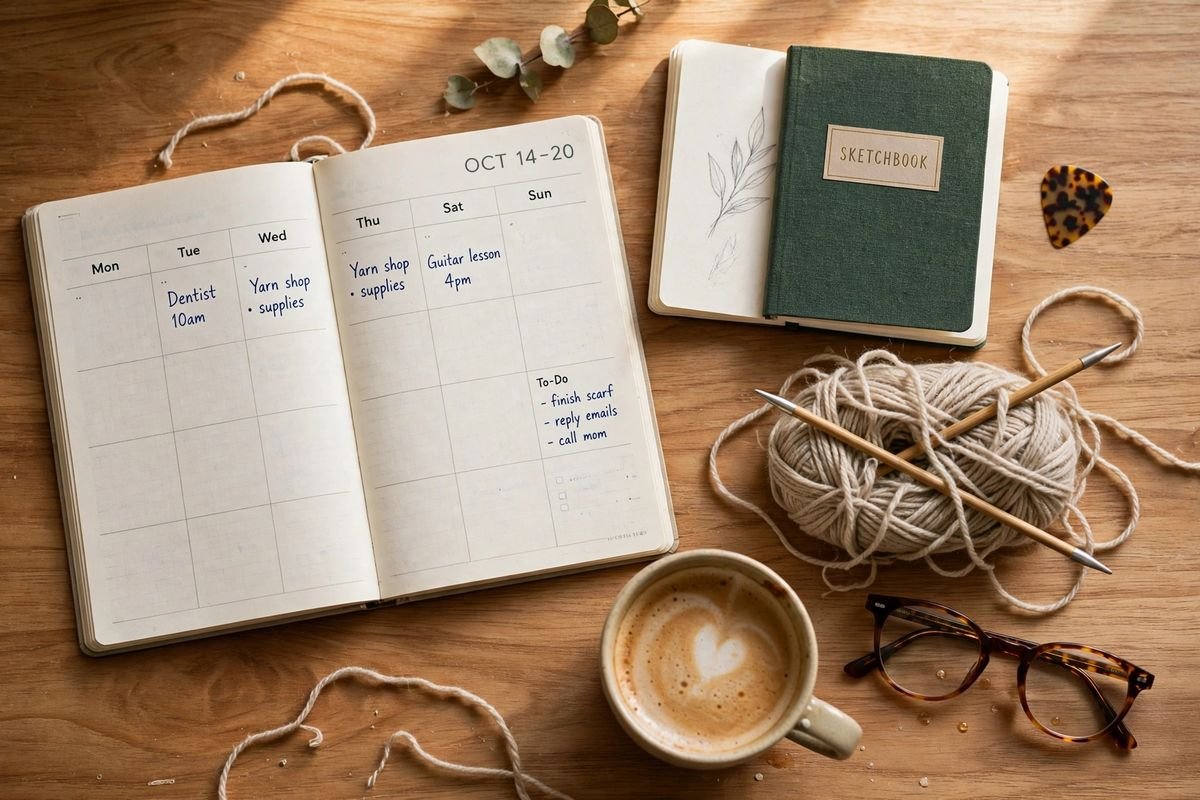
If a social version does not suit you, make the hobby visible instead. Keep the guitar within arm’s reach — leaning against the sofa, not zipped away in a cupboard. Keep the sketchbook open on the kitchen table. Put the half-finished knitting where you can see it. Out of sight is out of mind, and out of mind is where hobbies go to die. A visible hobby nags you gently every time you walk past it, and that nagging is useful — it is the hobby asking for its fifteen minutes.
What to Do When Life Gets Loud Again
No system survives every season. There will be weeks — a new baby, a work deadline, a parent in hospital, a house move — when fifteen minutes genuinely does not exist, and pretending otherwise just adds guilt to an already hard week. The difference between people who keep hobbies for decades and people who lose them is not that the first group never stops. It is that they know how to stop without quitting.
Build the pause into the plan. Decide in advance that a bad week means a pause, not a failure, and decide what the restart looks like: the first morning after the deadline, the guitar comes back out for ten minutes.
And when you come back, come back small. The temptation after a month away is to make up for lost time with a heroic session, and that is exactly how a pause becomes a permanent stop — the heroic session feels like too much, so it gets postponed, and the hobby quietly dies a second death. Fifteen minutes, one day, no ceremony. It is simply there, waiting for you to pick it up again, the way it always was.
Frequently Asked Questions
I genuinely work long hours and have young children. Is fifteen minutes a day realistic for me?
Yes — and it is realistic precisely because it is small. Fifteen minutes is the length of a child’s bath, or the time the pasta takes to cook, or the gap between the school run and the first meeting.
How do I choose a hobby if I do not know what I enjoy any more?
Start with what you liked before life got busy, even if it feels distant — most adults have one. If nothing comes to mind, try three things for two weeks each and keep the one you think about between sessions.
My partner thinks hobbies are a waste of time when there is housework to do. How do I handle that?
Show, do not argue. A short, regular hobby that visibly improves your mood is a much better case than a debate about the value of leisure. Offer a fair trade — you take a chore at another time — and keep the sessions short and predictable so they never feel like disappearing.
Should I spend money on equipment before I know whether the hobby will stick?
No. Start with the cheapest possible version — borrow, rent, use what you already own, or buy second-hand. A new guitar does not create a guitarist; fifteen minutes a day does. Spend only after a month of sticking with it.
What if I keep starting hobbies and abandoning them after a few weeks?
That is information, not failure. Look for the pattern: did each one need too much setup, too much travel, or sessions that were too long? The fix is usually to shrink the hobby, not to scold yourself. Pick one, cut the session to fifteen minutes, attach it to a daily anchor, and give it a full month before judging it.
You do not need to rebuild your life to have a hobby. You need fifteen minutes, an anchor, and a decision that your own enjoyment counts as a legitimate use of time — because it is. The guitar in my friend Tom’s house is still leaning behind the laundry basket, but last month he took it out on a Tuesday, tuned it, and played for twenty minutes while the twins slept. That short session, he said, had lifted his whole week. Yours is waiting too. Start tonight, for fifteen minutes, and let the habit do the rest.